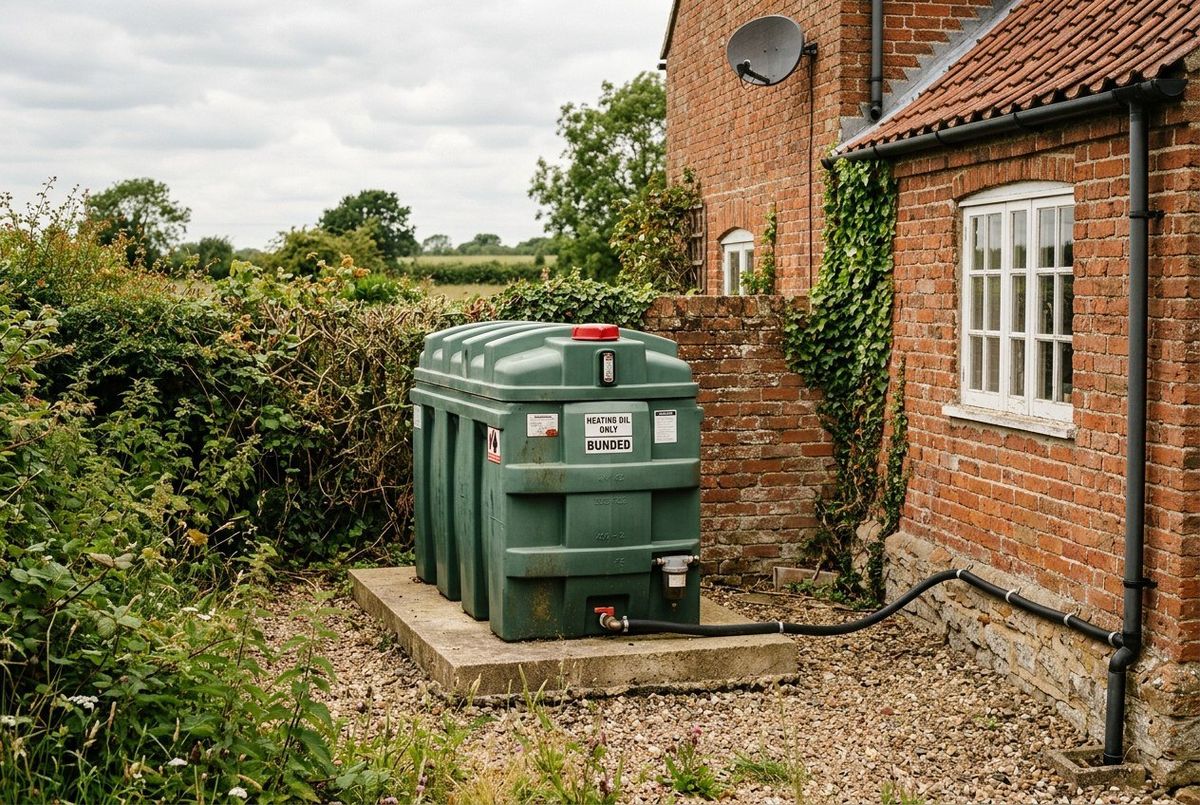
Thousands of Lincolnshire homes off the gas grid rely on a heating oil tank. The rules are mostly about where the tank sits and what happens if it leaks.
In much of rural Lincolnshire, from the Wolds villages to isolated Fen farmhouses, the mains gas network simply does not reach. Oil-fired central heating fills the gap, and with it comes a tank in the garden. Most of the time it is forgotten until a delivery is due. But installing or replacing a tank is controlled work, and a leaking tank can be expensive and environmentally damaging. This guide summarises the rules for a typical home in England. It is general information; for a specific installation, follow the advice of a qualified technician and your local building control team.
Which rules apply to a home
Two sets of rules are relevant.
- Building Regulations, Part J (combustion appliances and fuel storage). These apply when a new or replacement oil tank is installed at a home. The government's guidance is published as Approved Document J.
- The oil storage regulations (the Control of Pollution (Oil Storage) (England) Regulations). These cover larger stores and businesses. According to the government's guidance on storing oil at a home or business, they apply to homes only where more than 3,500 litres is stored. Most domestic tanks are smaller than that.
Whatever the size, you are responsible for any pollution your oil causes, and that is the practical reason the rules exist.
Installing or replacing a tank
Because a new or replacement tank is building work, it must either be installed by a technician registered with a competent person scheme, who can self-certify the work, or be notified to building control before it starts. For oil, the main competent person scheme is run by OFTEC. A registered technician will issue a certificate when the job is done and notify the local authority. Keep the paperwork with your boiler records.
When a bunded tank is needed
A bunded (integrally bunded or double-skinned) tank has an outer skin designed to contain the oil if the inner tank fails. Under the guidance, secondary containment is required in a number of situations, including where:
- the tank holds more than 2,500 litres;
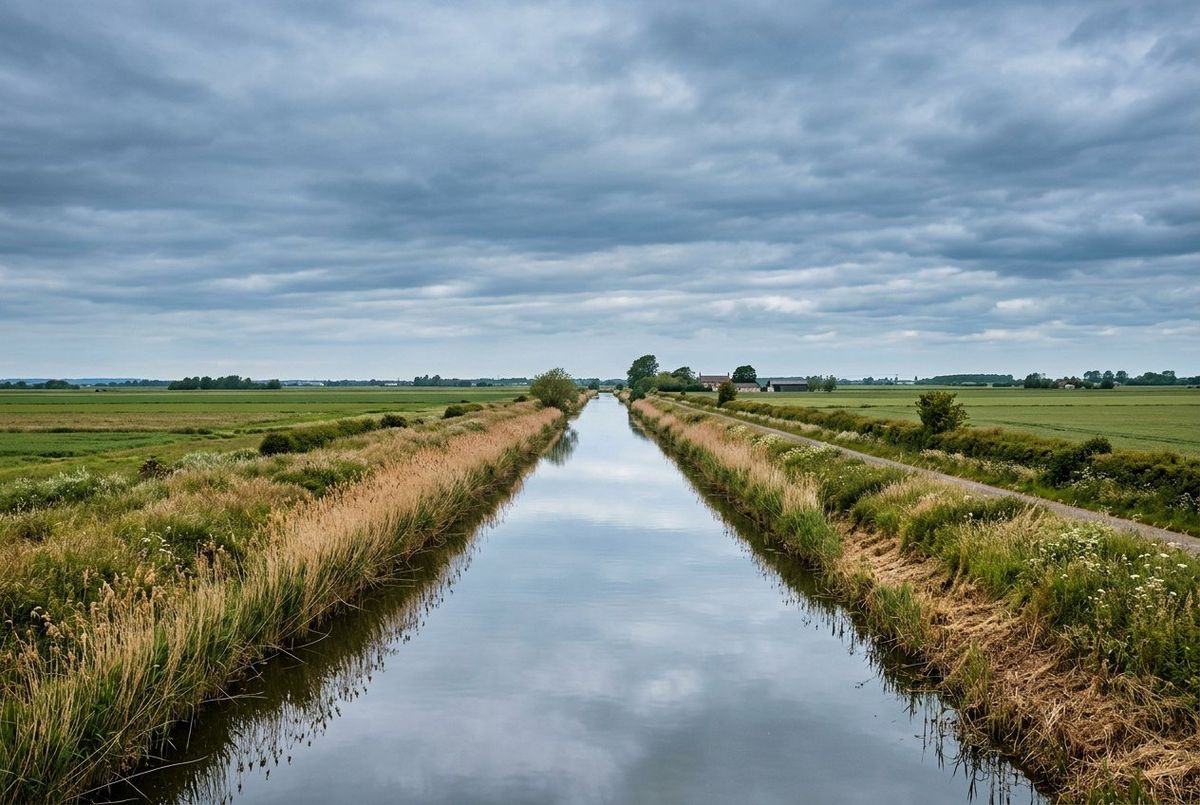
- it is within 10 metres of inland or coastal waters, such as a river, stream, pond or drainage ditch;
- it is within 50 metres of a well, borehole or spring;
- spilt oil could run into an open drain or a loose-fitting manhole cover;
- the tank's vent pipe outlet cannot be seen from the filling point;
- it is located where oil could run over hard ground and reach water.
In the Fens and the coastal marsh, almost every property sits near a drain or dyke, many of them maintained by internal drainage boards. That makes a bunded tank the normal choice. In practice most replacement domestic tanks sold today are bunded anyway, and an installer will assess the site.
Where the tank can go
Part J also sets out fire separation distances. As a broad guide, a domestic oil tank should be kept:
- at least 1.8 metres from any part of a building that is not fire-rated, such as doors, windows and eaves, and from oil-fired appliance flue terminals;
- at least 760 millimetres from a boundary, unless a suitable fire-resisting barrier is provided;
- at least 600 millimetres from screening such as trellis or planting that is not part of the boundary.
Where those distances cannot be met, a fire-resisting wall or a fire-protected tank may be acceptable. This is exactly the kind of detail an OFTEC-registered technician or building control officer will confirm.
The base
A tank needs a firm, level, non-combustible base, typically concrete or paving slabs, which extends beyond the tank on every side, usually by at least 300 millimetres. Sinking or uneven bases are a common cause of stress cracks in plastic tanks.
Looking after an existing tank
A tank does not last forever. Check it a few times a year, and before each delivery, for:
- Plastic tanks: whitening, bulging, cracks or crazing, especially around the base and the fittings.
- Steel tanks: rust, weeping seams and damaged supports.
- Both: oil smells, staining on the ground, dying vegetation nearby, a damaged gauge, or water in the bund.
- A sudden unexplained increase in how much oil you are using.
Many heating engineers check the tank as part of an annual boiler service, and some insurers expect evidence that it is maintained. It is worth reading your home insurance policy: cover for oil leaks and the clean-up costs varies a great deal.
If oil leaks
Act quickly. Stop the leak if you can do so safely, contain the oil with sand, earth or absorbent material, and keep it out of drains and ditches. Report any spill that could reach a watercourse to the Environment Agency incident hotline on 0800 80 70 60, which runs 24 hours a day. Contact your insurer early, as specialist clean-up can be costly.
Related guides
For the wider picture of running a rural home, see rural and off-grid. If your property also has private drainage, the septic tank general binding rules explain your separate duties there. And if your boiler uses LPG instead of oil, the checks are different again: see how to check a Gas Safe engineer.